
Wakefield teenager wins £1,000 national science prize with comic strip on greener homes
A Wakefield teenager has won a £1,000 national science prize after impressing judges with a comic strip explaining how physics could help create the homes of the future.
Alex, 14, a pupil at Queen Elizabeth Grammar School (QEGS), claimed first place in the Institute of Physics' Eurekas competition with his entry The Physics Behind a Better Future.
His colourful comic strip and accompanying poster explored how technologies including solar panels, battery storage and improved insulation could make homes more energy efficient and help tackle climate change.
The competition attracted hundreds of entries from young people across the UK and Ireland, with participants challenged to answer the question “How can physics make your home ready for the future?”
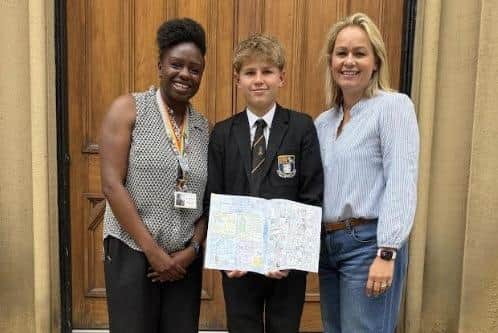

As the overall winner, Alex received a £1,000 prize.
Alex said: "I was really surprised when Mum told me she got an email saying I'd won – I couldn't believe it.
"I want to thank my physics teachers, Mrs Bracewell and Mr Hannard, for inspiring me and encouraging me to enter the competition.
"I love physics but I also wanted to explain how it can make a difference – and I thought a comic strip made the most sense for that."
Alex's mum, Helen, said the family were thrilled with the news.
She said: "We're all so pleased for Alex. We knew he had worked hard on different versions of his entry but didn't realise he'd actually submitted it, so the email from the Institute of Physics was a lovely surprise.
"His physics teachers at QEGS have been so supportive of his work and they've certainly inspired him to study physics further."
Sarah Bakewell, head of diversity and Inclusion at the Institute of Physics, said Alex's entry stood out from the moment it was read.
"One of the things that stood out for Alex's entry was that it was such a pleasure to read and I immediately wanted to show it to more people so they could see his sensational ideas.
"Not only has he shown that he understands the physics 100 per cent, but creating a comic strip to explain it is a clever and powerful way of showing how physics can make a massive difference for everyone."