
Column: Dr's Casebook" Dr Keith Souter: The two types of internal timekeepers that control your sleep
Sleep is still a mysterious part of life. We go to bed, fall asleep and dream. We know that good sleep helps our health and reduces the risk of various chronic illnesses, such as heart disease and type 2 diabetes. We also know that sleep is necessary to rest and refresh the brain. Yet the relationship between the quality of sleep we get and how refreshing it is seems hard to determine.
Sleep laboratory research from Belgium has found out that we have both an internal ‘clock’ and an internal ‘hourglass, which affect the way that different parts of the brain respond to sleep deprivation.
In this study a group of 33 healthy volunteers were asked to stay awake for 42 hours, during which time they had tests of their mental sharpness. MRI scans were used to look at brain activity during tests of concentration and reaction. As expected, they found that performance worsened the longer one was deprived of sleep. Fascinatingly, they found a complex interaction between two biological processes. Firstly, the body’s ‘circadian rhythm’, which stimulates the person to be wakeful and active during the daylight and to wind down when it gets dark. Secondly, the ‘homeostatic sleep drive,’ which pushes the person to want to lie down and go to bed when they have been awake for too long.
You can think of the circadian rhythm as being like a clock, which keeps going round in a regular rhythm, while the sleep drive is like an hourglass, which eventually runs down. The clock determines the timing of your sleep and waking by responding to light and darkness. The hourglass runs out the longer you have been awake and makes you crave sleep.
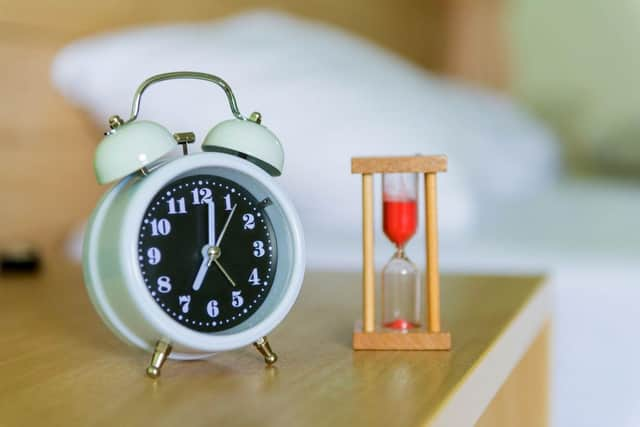

This is why if you stay up all night, you won’t sleep the whole day to compensate. You’ll only sleep a few hours, because the internal clock goes off, despite the hourglass being empty. In other words, the main determinant of how long you will sleep is the internal clock, not the internal hourglass. This is relevant for shift workers, long distance travellers and people on call for emergencies.
It seems that a key to overcoming insomnia is to try to get the two internal timekeepers operating in harmony.