
Dr's Casebook column with Dr Keith Souter: Your ear is a little like a teapot
You may have gathered if you regularly read this column, that I write a lot about tea. I keep up with all the research done on the subject, I try the different varieties of the drink, and a few years ago I infused all that into a book, The Tea Cyclopedia.
But it is not just tea that I am interested in, I also am always on the lookout for teapots that pour well. And in considering this, you may be interested to know that a teapot is a little bit like the human ear.


You may not have taken much notice, but you will find a small hole in the lid of most teapots. Or at least in the lids of those pots that pour well, provided they have a good spout.
Without a hole a well-fitting lid would create a partial vacuum inside the pot. This would occur because without a hole in the lid, air would try to force its way through the spout, causing the flow to chug, or glug or splutter. The hole permits air to enter the pot continuously which will push the tea through the spot in a nice even stream. Effectively, it acts to equalise the pressure between the outside and inside of the pot and prevent the partial vacuum from forming.
So how is this like the ear?
Well, the teapot and the middle ear are both like closed chambers. The rigid lid of the teapot seals the top of the pot, and the ear drum seals the middle ear from the ear canal. Both are barriers.
The Eustachian tube has the function of equalising the pressure outside and inside the middle ear. The hole in the teapot lid does the same between the outside and the inside of the pot above the tea.
The anatomy of the ear
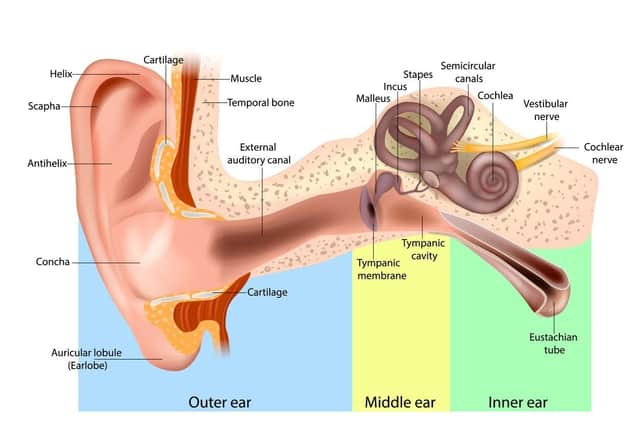
The ear is considered to have three parts, the outer, middle and inner ear. The outer ear consists of the pinna, that’s the external ear, and the ear canal. The middle ear is a closed chamber containing the three ossicles, the ear bones which are attached to the ear drum. These are the hammer or malleus, the incus or anvil, and the stapes or stirrup. The inner ear consists of the cochlea, a snail-shaped structure, which is the hearing organ, and the semi-circular canals, that form the balance organs.
You hear by sound waves being collected by the pinna and then vibrating the ear drum. This is transmitted by the hammer, anvil and stirrup conducting the sound through the middle ear to the cochlea in the inner ear.
The Eustachian tube, which was first described by Bartolomeo Eustachi (1513-74), the great Italian anatomist of the Renaissance, and named after him, connects the middle ear with the back of the throat.
When you descend in a plane the air pressure inside the plane increases rapidly, so the ear drum is pushed inwards, and the Eustachian tube collapses. The ossicles get bunched up and your hearing will be muffled. When the Eustachian tube opens, the high pressure in your throat pushes the ear drum back and you experience the ear-popping.
This is like closing the hole of the teapot lid mid-stream. It will stop the flow and create a partial vacuum. When you release it, air rushes in and it will glug – like popping your ear.