
Dr's Casebook column: Let's celebrate the poetic genius of Robert Burns
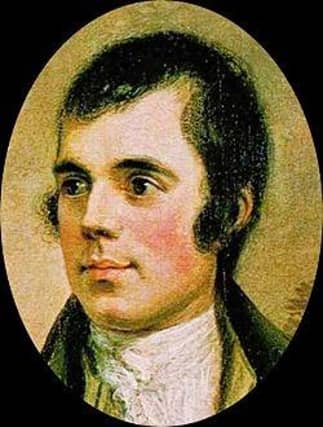

It is Burns Night on January 25, the anniversary of the birth of one of Scotland’s national heroes. Few poets have ever been accorded such worldwide fame.
Just think about it, only a few weeks ago on New Year’s Eve you may well have been singing Auld Lang Syne, and just as the celebrations were going on in your neighbourhood, so they would have been going on all over the world.
As a Scot I have been a Burns fan virtually all my life. At the age of nine I was placed third in the school’s annual Robert Burns prize for my recitation of ‘A Red, Red Rose.’ Sadly, I no longer have the certificate that I received for it. And if you do attend a Burns Night somewhere you are likely to hear of my namesake, ‘Souter Johnnie,’ one of Tam o’ Shanter’s drinking cronies!
Burns’ life was all too short. He died in 1796 at the age of 37, from a mixture of rheumatic heart disease and probable endocarditis, an inflammation of the heart, thanks in part to dubious medical advice to bathe in the cold waters of the Solway Firth. It is thought that a streptococcal infection entered his blood after he had a dental extraction in the winter of 1795. Poor nutrition was also a probable factor, for there were three months of food riots until March 1796.
Sadly, on the day of his funeral, which drew a crowd of many thousands, his widow was giving birth to his fifth child, his son Maxwell. She was literally without a shilling to her name.
He was originally buried in St Michael's Churchyard, Dumfries, in a simple grave, but his body was removed in 1817 and placed in a mausoleum built by public subscription. When his wife Jean died in 1834 the mausoleum was opened so that she could be laid beside him. Bizarrely, a plaster cast of his skull was then made to see whether phrenology could show where the genius of Robert Burns was located in his brain.
Phrenology was the name given to a school of thought devised by a certain Dr Gall in 1800. Essentially, it attempted to associate faculties of the mind with anatomical areas of the brain. It was at that time thought that the contours of the brain were mirrored by the contours and bumps on the skull.
This cast was examined by the famous Edinburgh phrenologist George Combe who wrote a monograph about it entitled Phrenological Development of Robert Burns. He concluded that Burns had a highly active brain and enhanced development of the faculties of the brain associated with both language and mathematics.
The former characteristic would have been apt for a poet, yet the latter is dubious, since all of his life Robert Burns proved to have little aptitude for figures, business or money.
Nowadays we know that phrenology was utter nonsense, yet there is no disputing the genius of Robert Burns.