
Collection of Barbara Hepworth drawings and working notes sells at auction for £25K
An archive of annotated sketches and correspondence showing the working methods of Wakefield-born sculptor Barbara Hepworth have been sold at auction for £25,200.
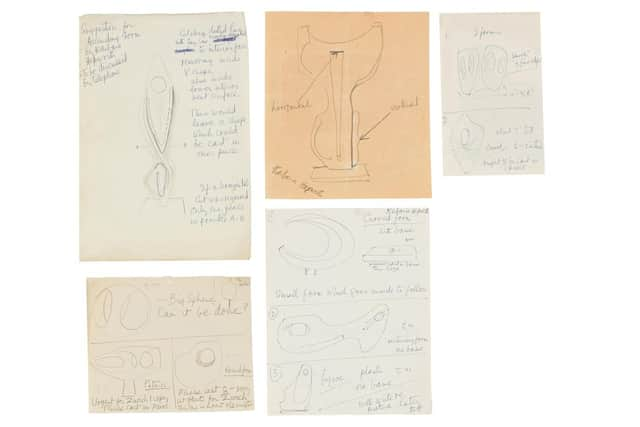
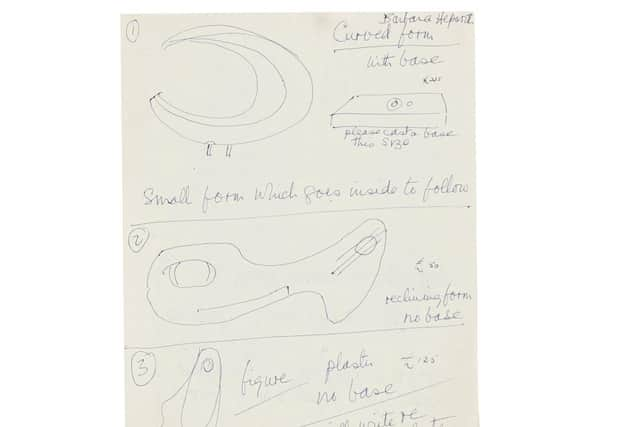
The five sketches accompanied by 39 letters from Hepworth to the London bronze foundry that cast many of her works came for sale at Chiswick Auctions’ sale of Modern British and Irish Art.
Estimated at £15,000-25,000, the collection was acquired by private buyer located in the UK, underbid by the UK trade.
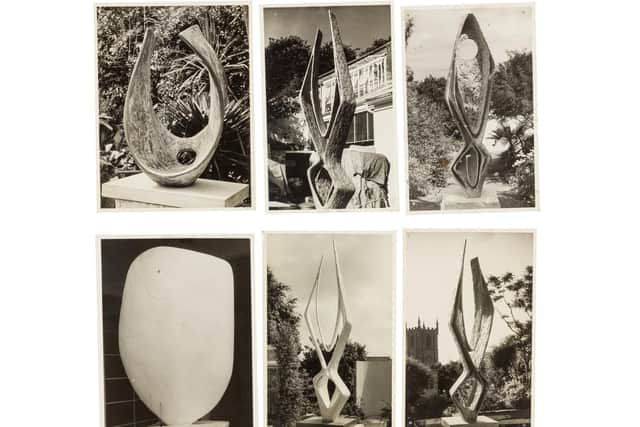
The intimate early pen and pencil designs for bronzes depict signature Hepworth works.

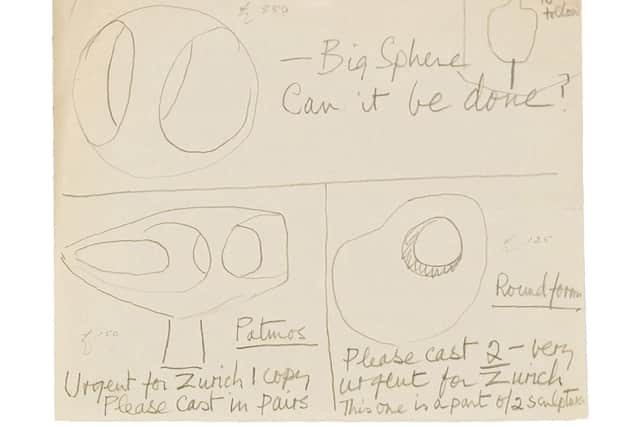
All were signed and extensively inscribed with working notes intended to aid the bronze casting process at the Art Bronze Foundry – better known as Gaskins.
The firm, a traditional lost-wax foundry, was established in 1922 by Charles Andrew Gaskin (1890-1969) and was later taken over by his son Michael Gaskin.
The cache of letters – 31 from Hepworth’s secretary and 24 carbon copy letters from the Art Bronze Foundry – were catalogued for sale with the help of Dr Sophie Bowness, a trustee of The Hepworth Estate.
The unseen and unpublished correspondence were dated between 1960 and 1971.
Extracts included some rich content. A typed letter on Trewyn Studio headed paper dated December 11, 1961, is addressed to Michael Gaskin at the foundry. It reads: “This is to confirm our conversation that you will do two copies of the new bronze Single Form and sand cast, by the end of January. Please keep the edges full and pure as I want to polish them… I am very interested in casting in gold. Can you give me an indication of say price?”
Later that month on December 29, 1961, Hepworth sends congratulations to Gaskin for his work on two bronzes. “We have just got the big one standing up on a lacquer base; and I am delighted with the little trap door that you have devised for the string sculpture!
"This is really most excellent, and could you proceed as fast as possible with the edition of the little one – do not number it as I will do it personally when I mount it.”
Following an unsatisfactory result on a bronze titled Chun Quoit 2, Hepworth writes with encouragement in March 1962. “Please do not say you have failed: On Chun Quoit 2 the back to front stance was excellent but does not lean quite so much over the right. I enclose a photograph of the plaster which might help you adjust the near straight line on the right hand of the sculpture which is running slightly vertical. The join at the bottom was excellent and please do not think me unappreciative”.
Close to a decade later in November 1971 the artist wrote to Gaskin with news that a bronze in Japan “is in a very poor state as regards to patina.” She adds: “I had always thought Japan as a clean country, but all my bronzes were returned in a very black condition. Would it be possible for you to re-patinate this cast for me sometime soon…?”
The archive came for sale from the family of Charles Gaskin.
Everything you need to know about Barbara Hepworth:
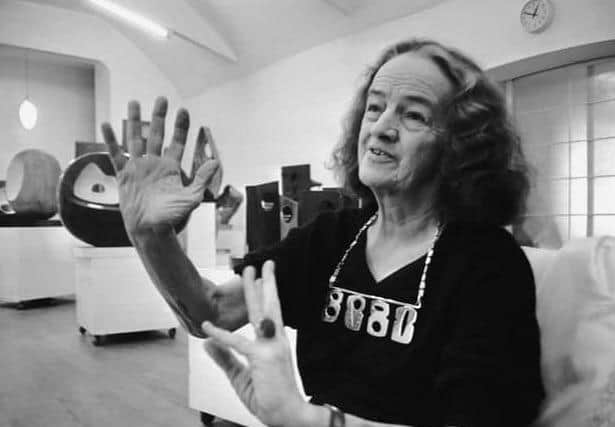
Barbara Hepworth is considered one of the most influential artists of the 20th century, and was one of the leading practitioners of the avant-garde method of Direct Carving, which saw artists work directly on the chosen material, instead of making preparatory models which would be transferred to their final model.
She worked around the world before settling in St Ives, Cornwall, in 1939 where she would live until her death.
Throughout her career, she produced hundreds of sculptures, influenced by her upbringing in the rural and industrial landscapes of West Yorkshire.
Her work was considered part of the abstract movement, and featured many natural forms and textures.
Born in Wakefield in 1903, Barbara Hepworth attended Wakefield Girls' High School. In 1920, she won a scholarship to Leeds School of Art, where she met fellow sculptor Henry Moore, who was born in nearby Castleford.
Following a period of study at the Royal College of Art in London, she travelled to Italy, where she worked alongside fellow sculptor John Skeaping. The pair married in 1925, and welcomed a son, Paul, in 1929.
In 1934, Hepworth welcomed triplets with artist Ben Nicholson, whom she would later marry. She said that she was "nourished by this rich life" of raising her children while continuing her work, and tried to find time for her work each day.
Following the outbreak of the Second World War, Hepworth and her family relocated to St Ives, Cornwall, along with many other artists. Later, she would move to Trewyn Studios in the town.
During her time in St Ives, Hepworth worked alongside a number of other sculptors, and co-founded the Penwith Society of Arts.
Her work continued to be displayed around the world, including London, New York, Venice and many more.
In 1965, she was made a Dame Commander of the British Empire.
But tragedy struck on 20 May, 1975, when Hepworth died in an accidental fire at Trewyn Studio, at the age of 72.
Despite this, her legacy lives on - a museum in her name opened in her hometown of Wakefield in 2011, and more than 600 of her sculptures remain on display around the world, including at the Yorkshire Sculpture Park.