
Work to begin on long-awaited project to re-open 200-year-old former crown court building
Plans to transform Wakefield’s former courthouse into a new ‘village hall’ for the city have been given the go-ahead.
Work is due to begin on the long-awaited project to re-open the 200-year-old former crown court building.
In May, the Yorkshire-based developer behind the development put forward amended plans for the Grade II*-listed building.
The landmark site on Wood Street is to be transformed into a multi-use arts venue to include a food hall, offices, events space and studios.
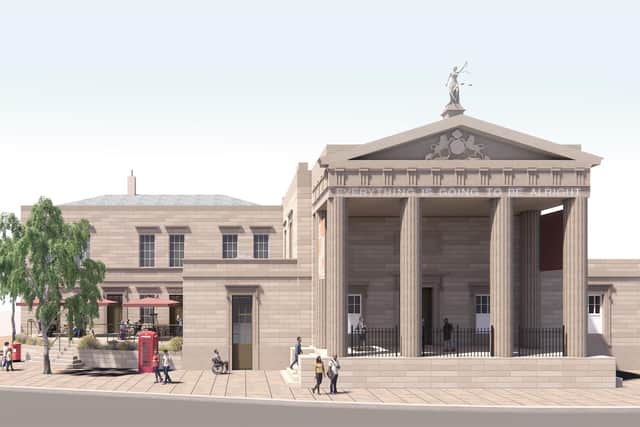

Heritage specialist Rushbond said the development would be the “final key piece” in the regeneration of Wakefield’s civic quarter.
The designs include plans for a redesigned public terrace sympathetic to the building’s Georgian stonework, along with planters and a balustrade.
They also feature a “layered internal layout that brings new life to each courtroom and office.”
A new entrance at street level is planned to allow public access.
A neon sculpture by a Turner Prize-winning artist will be installed on the building.
The artwork, which reads “everything is going to be alright”, has been designed by globally acclaimed artist Martin Creed, who was born in the city.
The courthouse was built in 1810 and later extended but has been derelict since it closed in 1992.
Rushbond said the venue would be “a kind of modern-day village hall for the city” when it opens in summer 2026 and would “underpin” ongoing residential developments nearby.
Approving the scheme, a planning officer’s report said: “The proposed works have been clearly justified and are considered to be acceptable in protecting and enhancing the Grade II*-listed building
“Whilst some of the works would result in less than substantial harm, the public benefits on improving the indoor and outdoor spaces and providing an improved access into the building, together with the building being brought back into use, are considered to outweigh such harm.”
Kevin Trickett, president of Wakefield Civic Society also welcomed the proposal, saying: “We are pleased to see that the proposed repurposing will allow (and, indeed, encourage) public access to what is undeniably one of the city’s landmark buildings.
“Overall, we think that the revised scheme will offer both an attractive and accessible solution, particularly with the ‘village hall’ concept.
“Combined with the restaurant and bar, and the flexible work spaces, the courthouse will provide an exciting addition to Wakefield’s growing events and cultural scene.”
Jonathan Maud, founder and chairman of Rushbond, previously said: “Wakefield’s historic administrative city status means it’s got more than its fair share of heritage and architectural jewels.
“We are proud to be in a position to restore one of its most dazzling, the former crown court, into an important destination at the heart of the city’s life once again
“This development is part of a bigger wave of change happening across the city.
“It’s becoming a place where culture, business and community thrive, and where people can afford to live and work in a great compact, well-connected and inclusive city.”
In 2021, the council agreed to convert the civic quarter into a new neighbourhood with homes and public facilities.
Plans include re-purposing one of the most historic areas of the city centre as a place where people can live, work and socialise.
The former police station on Wood Street is being converted into flats as part of the project.
The scheme also includes building townhouses on Rishworth Street and Gills Yard.