
St Thomas à Becket: Raac-affected school set to for major redevelopment
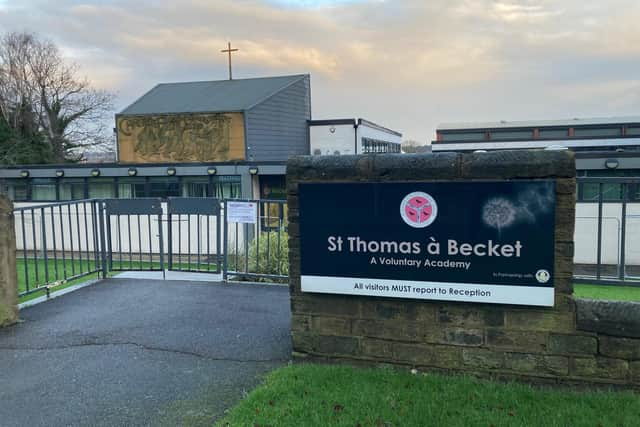
Plans have been drawn up to carry out a major redevelopment of a Wakefield school built with potentially unsafe concrete.
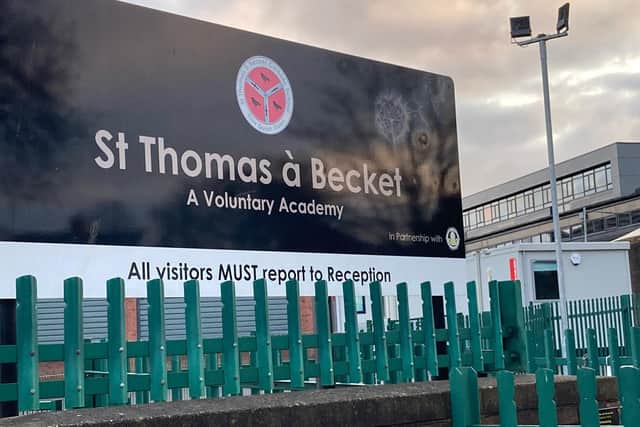
St Thomas à Becket Catholic Secondary School, in Sandal, was one of 234 schools in England found to have reinforced autoclaved aerated concrete (Raac), which can deteriorate over time and pose a structural risk.
Proposals are due to be submitted to Wakefield Council to demolish “the majority” of buildings within the school site to make way for modern facilities.
Documents submitted to the local authority said the school, on Barnsley Road, had been identified as a priority within the government’s school rebuilding programme “due to its significant condition and safety issues, which affect day‑to‑day operations, pupil safety, and the school’s ability to provide high‑quality learning environments.”

A formal planning application is yet to be submitted but details of the scheme are outlined in a request for a screening opinion from the council.
Planning regulations require applicants to request a screening opinion if the size of urban development projects exceed one hectare.
They indicate to developers how likely an environmental impact assessment (EIA) would be needed before an application is submitted.
Initial plans include the construction of a three-storey building, new parking and access, a sports area, landscaping and a special educational needs and disabilities (SEND) garden.
The installation of a new substation and drainage works were also planned.
A two-storey building within the site, which houses a sports hall, would be retained and refurbished.
When completed, the new facility would provide 7,334 sq m of floorspace within the 5.6 hectare site.
The report said: “The redevelopment proposals will see the demolition of several blocks which have been identified as being in poor condition, containing Raac or having structural or functional deficiencies.
“Redevelopment will replace outdated accommodation with safe, modern and sustainable facilities.
“The building will broadly take the form of an L-shaped arrangement, consolidating the number of buildings on site, particularly where they front Barnsley Road.
“The delivery of the proposed scheme will be phased, minimising disruption and enabling the ongoing operations of the school on-site.”
The school had to be temporarily closed in October 2023 following the discovery of Raac.
It later reopened to Year 11 pupils, while others studied at home.
In January 2024, the school announced that a “village” of temporary classrooms would be installed to house more than 600 pupils.
Raac has a lifespan of around 30 years and was used between the 1950s and 1990s as a lightweight construction material.
In August 2023, schools, colleges and nurseries in England were forced to shut when the Raac in the properties was found to be dangerous.
The Department for Education (DfE) committed to fund the removal of Raac in educational establishments in February 2024.